Comprehensive guide covering essential IELTS preparation strategies and techniques to help you achieve your target band score.
Originally published May 2020. Last reviewed 3 July 2026.
In this post, we will look at the common topics that are seen again and again in the IELTS writing task 2 test. Students often ask if the questions are repeated year after year and the answer is no, but the topics are. There are so many questions written each year, you may find you practice answering various questions on different topics. For example, you could write essays to answer questions about education or the environment, which benefits you because you learn vocabulary associated with those topics and develop ideas that can help you in your writing test.
Practicing writing IELTS task 2 essays on a range of topics is a great way to learn new vocabulary for those topics, but also to practice your essay structures. You begin to develop your ideas around those topics, thinking of examples and giving your opinions.
WRITING TASK 2 COMMON TOPICS
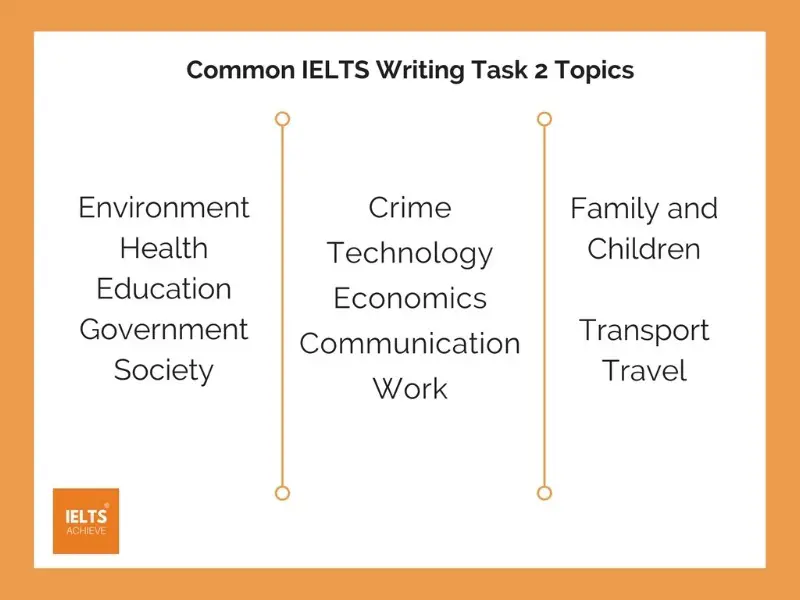
The list below shows you the common topics that are seen every year.
There is quite a range of writing task 2 topics, with many subtopics. Take a look at the list below and look for questions in each area when you are completing your IELTS preparation >
Environment
Government legislation
Environmental problems
Climate Change
Animals
Health
Obesity
Hospitals
The elderly
Funding
Poor countries vs rich countries
Health education
Exercise
Education
The rise of technology
Subjects/curriculum changes
Uniforms
The role of teachers
Discipline
Funding
Rules
Government
Change to laws
Rules that affect groups of individuals
International laws
Benefits to individuals and society
Funding
Society
Poverty
Overpopulation
Homelessness
Modern lifestyles
Funding
Public services
Crime
Youth crime
Punishment
Repeat offenders
Major vs minor crimes
Prisons
Technology
The role of technology in our lives/in society
The internet
Social media
Children online / safety measures
Hacking/data protection
Economics
World spending
Cash vs credit cards
Economic progress and success
Communication
Technology
Family
Social media
Types of personalities
Characters in society
Work
Women in the workplace
The role of the employee
Employer vs employee issues
Types of jobs
Salary
Equality
Family and Children
Family roles
Family size
Role models
Discipline (parents to children)
Education
Transport
Different forms of transport
Comparisons
Problems
Environmental issues
Travel
Culture differences
Travelling benefits/drawbacks
Meeting people
Forms of travel
There are many other topics that you can also prepare for, including art, business, marketing, sport, reading, language and food/diet.
TOP TIPS FOR PREPARATION
TIP >> When you are preparing for your IELTS writing task 2 test, practice answering questions on topics that you find difficult, as this is really good practice.
TIP >> Learn vocabulary associated with the topic. Make word lists and learn the meanings of those words.
TIP >> Read around the topic, take a look at news websites or journals and read about these topics. What is happening in the news? Can the news stories give you ideas for examples that you can use in your essay?
TIP >> Listen to TED Talks, podcasts, the news or documentaries related to the common topics and develop ideas, vocabulary and your opinions.
TIP >> Practice talking about these topics with a friend. Ask them their opinion about something you have seen in the news and give them your opinion, discuss the latest news and events related to the common topics.
We hope you found this post useful in helping you to study for the IELTS Test. If you have any questions please let us know in the comments below or on the Facebook page.
The best way to keep up to date with posts like this is to like us on Facebook, then follow us on Instagram and Pinterest.
If you need help preparing for the IELTS Test, join the IELTS Achieve Academy and see how we can assist you to achieve your desired band score. We offer an essay correction service, mock exams and online courses.
Expert tips and strategies for this part of the IELTS Speaking test. Includes sample responses and key vocabulary for Band 7+.
Originally published May 2020. Last reviewed 3 July 2026.
In this post, you will see one of the most common IELTS speaking topics for part 3 (The Environment) and sample answers.
Please remember that in the actual test you should give honest answers and talk about your own experiences, thoughts, feelings and opinions. Do not try to memorise answers, as the examiners will probably be able to guess and you will lose marks.
However, you are able to make up information to extend your answers, but be sure that you are confident when speaking about the chosen topic and that it is believable.
TIP >> Listen to the questions the examiner asks you and think about the structure of the question. Are they asking your for your opinion? or to say how something has changed from the past to the present?
TIP >> Learn about the most commonly asked question types used in the part 3 questions. This will help you to identify how you should respond and what to look out for when you are practising.
TIP >> It is common for many people to say ‘I don’t know’ or to lose focus when they get a question they know little about. Always answer the questions and if you feel as though you don’t know about the topic, then buy yourself some time by saying; ‘I haven’t really thought about that before…. but in my opinion……’ then give your opinion, etc.
TIP >> Don’t try to answer the questions as quickly as possible, take your time and answer them to the best of your ability. Give your opinion, the reasoning behind it and support with specific examples.
Take a look at the questions and sample answers below on the topic of ‘The Environment‘ >>
Q. What causes environmental problems?
A: I think that there are many things that are harming the environment, including greenhouse gases, fossil fuels and pollution. One of the main causes that I have an interest in is pollution caused by plastic. This is a huge issue that is making the environment suffer, on beaches, in the sea and in other places. People not choosing to use reusable shopping bags is having a huge effect on the amount of plastic that is going to waste.
Q. What should the government do to protect the environment?
A: In my opinion, they should make more incentives for people to learn about how they can help at an individual level. If they could educate people and make more rules about recycling or using plastic bags, then perhaps we would see a difference. I read in the news recently about how Kenya has passed a law, making it illegal to use plastic bags. In the UK they have a price for a plastic bag. But maybe this type of law, making them illegal should be implemented everywhere. The governments should unite and work together to combat these problems before it is too late.
Q. What should we do to protect the environment?
A: Obviously we all have a responsibility to do something to prevent the deterioration of the environment. Ever little bit that we can do as individuals could help, for example by recycling our household waste, donating clothes to charity, going on litter clean-ups and using reusable shopping bags. I always use cotton bags for my grocery shopping instead of plastic bags and recycle as much as I can.
Q. What other measures can you think of to protect the environment?
A: We can all do something to help, for instance, get together with groups of friends to collect litter from beaches or other public places. We can also walk or cycle more, rather than driving, use less electricity, recycle waste and limit the use of plastic bags. On a wider level, the government should impose more laws that protect the environment.
Q. How should we educate children to protect the environment?
A: Children should be taught in school about the effects of things we do that can be harmful to the environment. They can complete projects and work together to learn about how to recycle and the importance of it. They could also complete work outside, looking at how to preserve wildlife, plants and flowers. It is really important that they learn about this at an early age so that they can grow up with some awareness of the impact their actions can have.
Q. What’s the difference between the old and the young as regards environmental protection?
A: In my view, I think that older people seem to be more aware and have a larger concern about protecting the environment, whereas younger people are very self-obsessed nowadays. They are more interested in looking at their social media apps and taking selfies, than about caring for the environment. Older people run groups that meet and pick up litter, clean beaches of plastic waste and run charity events. Some younger people may also do these things, but most are too self-involved to actually do something that can make a difference.
You should spend about 20 minutes on Questions 14-26, which are based on reading text 2.
Robotics in Healthcare – Get ready!
While there are concerns about machines replacing people in the workforce, the benefits are tempting. Imagine how a machine that doesn’t need sleep or food, doesn’t have prejudices that we humans so often have could change the way we treat people who are sick and vulnerable. With some preparation and forethought, we can make sure the human touch stays relevant in medicine while taking advantage of our metallic allies. For this reason, here are some interesting examples of robotics in healthcare.
Surgery is an unpleasant experience at best. The waiting lists can be long depending on available manpower and resources. daVinci helps alleviate the problem. It has been used in a wide variety of fields from head and neck to urologic surgery. The surgeon is in complete control of the system at all times, however as the machine has greater reach and flexibility, smaller incisions made with more precision are enough to access the problem areas.
During a hospital stay, patients interact with nurses the most. They draw blood, check your vital signs, check on your condition and take care of your hygiene if needed. They are often overwhelmed by physically and mentally daunting tasks, and the result is often an unpleasant experience for everyone involved. Robotic nurses will help carry this burden in the future. They are designed to be able to carry out repetitive tasks. This way the staff has more energy to deal with issues that require human decision-making skills and empathy. Certain robots can even take your blood sample.
But robotics in healthcare is so much more than drawing blood. With a remote controlled robot, such as the ones developed by Anybots Inc caretakers can interact with their patients, check on their living conditions and the need for further appointments. This would help efficiency a great deal by eliminating the time-consuming home visits. Companies producing and the ones maintaining the system will have to make great efforts to alleviate privacy concerns. As with every such device, it must be near impossible to access for non-authorized personnel. With the proper safeguards in place, these robots can greatly improve the lives of caretakers and patients alike.
Chances are you have been in a situation before where, if an accident were to happen, medical professionals would not have been able to reach you in time. To some of us in the developed world, it’s a rare occurrence. But even in 2016 billion live outside of the reach of conventional emergency services. With InTouch Health, patients in remote areas have access to high-quality emergency consultations for stroke, cardiovascular, and burn services. On the patient’s side, it can be accessed on a tablet or personal computer, and clinicians can also use the same type of devices as best suits their needs.
You have seen them in movies, taken advantage of them in video games and now they are here for real: exoskeletons. With the help of these devices paralysed people can walk, rehabilitation of stroke or spinal cord injury patients. They can enhance strength in order to allow a nurse to lift an elderly patient. While they have many exciting uses, it’s important to remember that currently, they are costly to make and power, so at least at first they will not be available for everyone. Although, in some cases, insurance companies had to cover the costs. Because of this, it has the potential to deepen already existing social and economic inequalities. Decision makers have to lay the groundwork to regulate the use of such devices. They will have to stay up to date on their capabilities to prevent misuse.
The great thing about robots is that they can be built to be so durable that they can overtake tasks that for humans would be simply too dangerous. Take Petman for example: designed for testing chemical protection clothing. It moves freely and can even adjust suit temperature and simulate sweating to provide realistic conditions.
Such solutions not only minimise the risk to human testers, in the long run, mechanisation of the supply chain makes production cheaper as well. Robots don’t need vacations, to eat or sleep. With a new generation of them more sturdy, agile and flexible than ever they increase productivity in all kind of factories.
Hospital acquired infections (such as MRSA) are among the leading causes of death in the US. According to CDC statistics used by Xenex show that in the United States, 1 in every 25 patients will contract an HAI. Of those, 1 in 9 will die. In addition to the human cost, it takes its toll financially as well. These infections cost more than $30 billion dollars a year. Xenex, a Texas-based company produces a unique robot. It uses high-intensity ultraviolet light to disinfect any space in a health care facility quickly and efficiently. The Xenex Robot is more effective in causing cellular damage to microorganisms than other devices designed for disinfection. It reduces the number of hospital-acquired infections. It’s yet another example of how robotics in healthcare helps hospital staff to decrease workload and will lead to a much friendlier environment.
As with nurses, pharmacists are burdened with tasks that could be eliminated by utilising the advancing robotics in healthcare. Heavy lifting, as always, is a big help, but a robot could process information much faster and much more accurately than humans. This way it could make more precise recommendations after sifting through the patient’s available medical data. Pharma dispensers could work as an ATM does, so no matter time of day patients can get access to their prescriptions. If robots were used for such tasks, pharmacists would have the time and the incentive to participate in the social aspect of healing: educate people of preventive measures, give practical advice and therefore make sure that healthcare truly becomes caring.
Questions 14-17
Do the following statements agree with the claims of the writer in text 2?
In boxes 14-17 on your answer sheet, write
YES – if the statement agrees with the views or claims
NO – if the statement contradicts the views or claims
NOT GIVEN – it is impossible to say what the writer’s views/claims are
14. Governments should do more to ensure that Robotics are readily available in the hospital systems.
15. Surgical procedures can be enhanced.
16. In the future, the healthcare system will increase its dependency on robots.
17. Hospitals in the United States reported that infections caught in hospital care cost the nation over 50 billion each year.
Questions 18-21
Complete the sentences below.
Choose ONE WORD ONLY from the text for each answer.
Write your answers in boxes 18-21 on your answer sheet.
18. In the future, medical robots will provide many ………………………… in the health care system.
19. Some machines or robotics will use data to increase …………………………………
20. With help from ………………………………… many people can walk.
21. Many robots can perform tasks that people cannot because they are too ………………………….
Questions 22-26
Look at the following names and list of statements below.
Match each name with the correct statement, A-H.
Write the correct letter, A-H, in boxes 22-26 on your answer sheet.
22. daVinci
23. Anybots Inc
24. InTouch Health
25. Petman
26. Xenex
List of Findings
A. Can perform autonomous head and neck surgery.
B. Provide specialist equipment for surgical procedures that give accurate lacerations.
C. Develop robots that can take blood.
D. Make health care workers that can investigate on patients easily.
E. Can offer healthcare services to those who live in remote places.
F. Can assist in lifting patients with spinal cord injuries.
G. Can perform jobs that are too risky for humans.
H. Ensures that spaces are kept clean, safe from the spread of epidemic particles.
If you need help to answer these questions with extra practice please read the posts below >>
We hope you found this post useful in helping you to study for the IELTS Test. If you have any questions please let us know in the comments below or on the Facebook page.
The best way to keep up to date with posts like this is to like us on Facebook, then follow us on Instagram and Pinterest.
If you need help preparing for the IELTS Test, join the IELTS Achieve Academy and see how we can assist you to achieve your desired band score. We offer an essay correction service, mock exams and online courses.